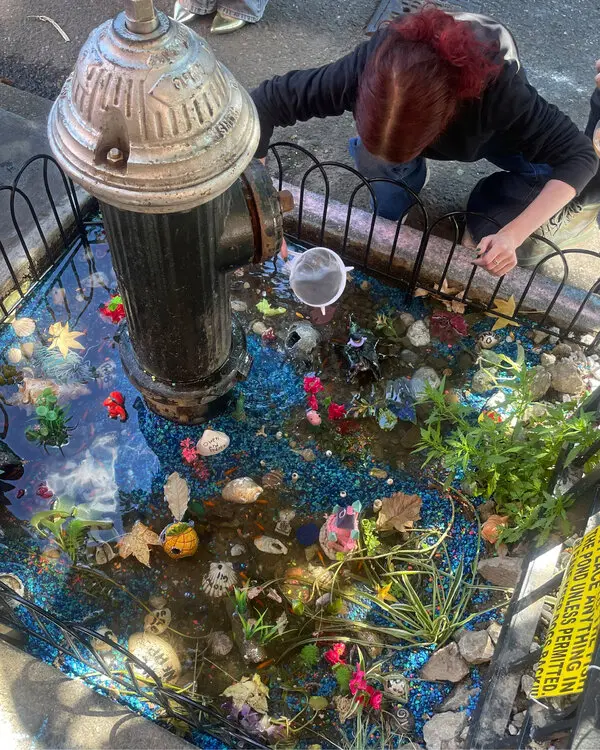
In the summer of 2024, a fire hydrant on the corner of Hancock Street and Tompkins Avenue in Bedford-Stuyvesant, Brooklyn, began to leak. At the time, I was a student of urban design, thinking a lot about repair, not as a technical problem but rather a social and political one, as part of my thesis work. I came across the story of the fire hydrant expecting to learn about the NYC city services helpline and the drawn out work orders that would help me trace required repairs. Instead, I found a story that changed my outlook on the subject altogether. What happened involved a few longtime residents of the neighborhood coming together to shore up the broken concrete with bricks and stones and create a pond for a 100 goldfish they got from a nearby pet store.
Source: New York Times (https://www.nytimes.com/2024/10/25/nyregion/bed-stuy-aquarium-sidewalk-brooklyn.html)
In the weeks that followed, the puddle became more than just a home for the fish. Neighbours brought out their chairs, someone installed a bookshelf full of donated children’s books, and a sign mimicking an official NYC Parks Department plaque was installed on the tree above. As news outlets began to cover this unique story, residents described how gentrification had been quietly eroding the neighborhood’s social fabric, and the fish pond seemed to have knit something back together. It brought people outside and gave them a reason to engage with each other.
Unfortunately, only a few months later, the pond was filled up with cement as part of repairs conducted by the department of environmental protection. Many residents spoke up against this, and some even left memorial candles in place of the pond.
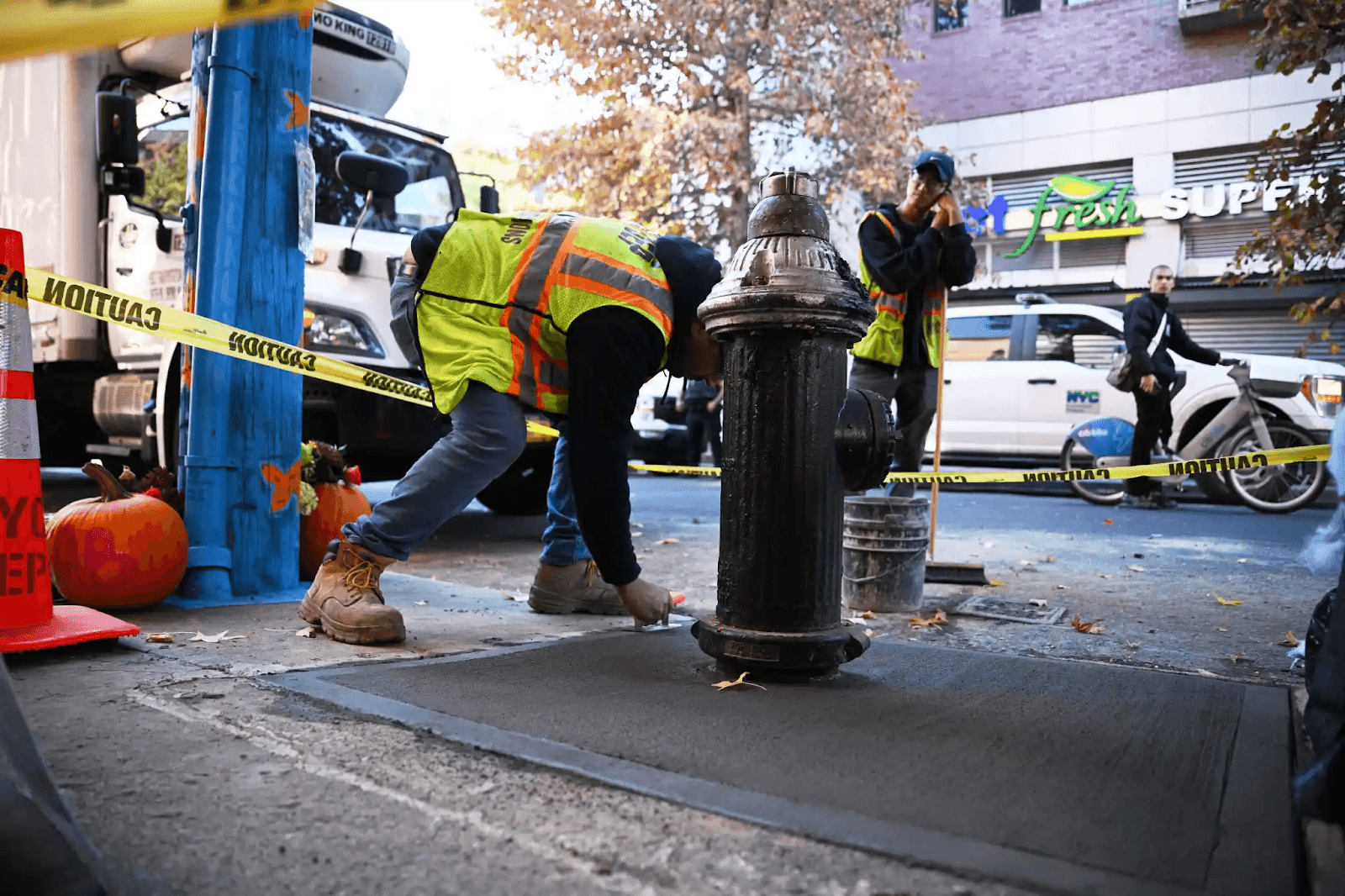
Photo by Lloyd Mitchell, Source: The Brooklyn Paper (https://www.brooklynpaper.com/bed-stuy-aquarium-paved-over/)
In learning about this story, I realized there is a lesson here that designers and urban thinkers need to sit with. Of course, the city was not wrong in its response to fix a fire hydrant, but how this process played out revealed a lot about how we understand what it means to “fix” things. The city’s response was to erase the traces of breakdown and restore it to its original state. But, what it could not perceive, because its systems are not built to perceive it, was that the problem had already been transformed into something with meaning, with social tissue, and with care attached to it. It prompted me to think that maybe repair is not just the restoration of an original state, maybe it is the negotiation of a new one.
In recent years, the broader political conversation around repair has taken shape through the Right to Repair movement, which began as a consumer rights campaign to demand that people should be able to fix their own devices and access replacement parts rather than being locked into manufacturer repair monopolies or forced into premature replacement. While this movement makes a case that feels primarily economic, there is an underlying argument about who gets to be the author of the things around them. It is about agency, legibility, and the embodied knowledge that comes from working with your hands on something that matters to you.
Shannon Mattern, a scholar whose work explores themes of care and maintenance in urban infrastructure, also points to this problem from a different angle. She suggests that the work of keeping things running and together is often systematically undervalued and made invisible. Maintenance is feminized, racialized, and made anonymous. We can see this from the perspective of the city, where the hydrant that gets fixed is a success story, but the one that is tended to, decorated, and transformed into a site of collective life gets paved over.
What would it mean to extend the principles of the right to repair into the scale of civic systems and spaces? Not simply to allow communities to patch what is broken, but to recognize community repair as a legitimate, and even generative mode of urban authorship?
This requires designers to do something uncomfortable by shifting focus from problem solving to treating incompleteness as a form of creative invitation. This not only means paying attention to how bodies move through, adapt, and contest designed environments, but also to understand that spaces are continually made and remade through their use, occupation, and improvisation. What the Bed-Stuy pond demonstrated is that these improvisations can be deeply social and collective, and that they require their own kinds of infrastructure grounded in trust and shared interests. In this manner the right to repair, applied at the civic scale, means designing systems that can be opened and adapted by the people who inhabit them.
The story of the Bed-Stuy pond continues as it was eventually rebuilt by community members in a nearby treebed. Despite the insistence of people to keep it going, it is harder to maintain without the hydrant’s steady water flow, and requires more work, ingenuity, and negotiations with a city that cannot quite see its value.
This is where designers can enter differently. Instead of being authors of finished spaces, we must act as people who make the work visible, the tolerances knowable, and future interventions possible. The question is not how to design things and spaces that can resist decay, but it is how to design systems, civic and otherwise, that remain open to being repaired, adapted and claimed by the people who live inside them.
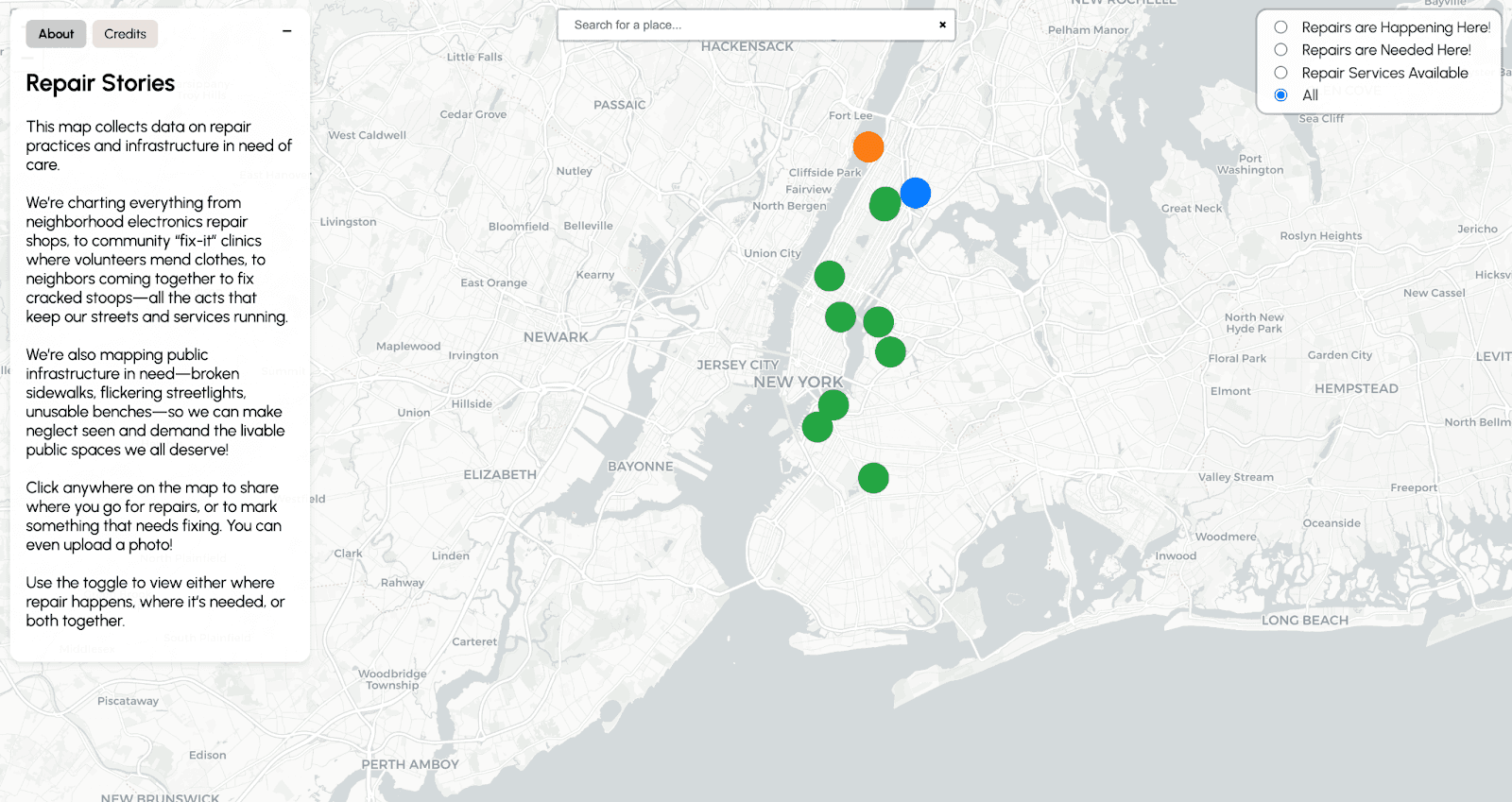
In trying to answer this question, I built an open-source map called Repair Stories, an attempt to do in practice what this essay argues for in theory: to make the invisible visible. The map collects everything from neighborhood electronics repair shops and community fix-it clinics to smaller acts of maintenance that keep streets and services running but rarely appear in any official record. It also maps the other side; infrastructure in need of care that no one has yet claimed. Anyone can contribute: click a location, add your repair story, upload a photo. The act of mapping is itself a form of repair, a way of insisting that neglect be seen and that the people doing the tending get counted. You can explore and add to it here.