As a design researcher, I take great joy in mapping the moments that are structurally transformative to humans especially, to their sense of self. In this [hopefully brief] reflective account, I’ll be sharing those pivotal moments of shift, change and redirection of my designerly self that I’ve known and practiced for a while.
After some years of working in the design world, grappling with where to direct my skills and consciously cultivating a community as I go, I was fortunate to go back to school to study a mix of design+health and care. A mix, I only ever joked about with friends, “I want to be a healer..” But, I always thought it to be with kitchen herbs and portions never, design.
Life unfolds humorously. The Master’s program stretches across three countries and binds you with different cultures, styles of working, thinking, being, expressing and occupying space. The multipluralism of Karachi could not prepare me for it; however, it did embed a sense of openness to alternatives and a lot of curiosity in me.
My first philosophical shift was to do with time.
For me, design had to bring a sense of “wow” or something that evokes in one a strong emotion but, during the thinking and understanding and evaluating this semester, I had to find ways to evaluate my work beyond conceptual and aesthetic appeal. This introduced a critical question into my designerly chest of knowledge: what happens to design in the long haul?
I remember being introduced to the idea of designing for a 100-year life during a two-day Care Lab masterclass led by Lekshmy Parameswaran and László Herczegwe. It made me reflect upon designing beyond immediate outcomes, this unsettled me. Partly because, the ability to plan for the future is a privilege enabled by economic security. If you’ve seen the last scene from Bong Joon-ho’s film Parasite (2019), you understand my reference.
This led me to my second shift - or more like a question. So how could I design for this polycrisis ridden world? Could uncertainty be a technology to work with? Can I speculate, dream, critique, create my way into the future?
In the beginning, to all things healthcare, I gravitated towards familiar methods of creative facilitation and intervention-based approaches - a method I’m familiar with. It doesn’t land in every context, I quickly learned. The discomfort opened me to value open-ended, participatory processes in which meaning could emerge through engagement. Towards the end of my first term, I also noticed a shift in my role within group settings, from advocating for well-versed ideas toward making space for listening, silence and collective sense-making. This reorientation allowed uncertainty to function as a site for speculation, experimentation and shared learning.
A further shift in my practice has been my relationship to scale and tempo and how these shape my design decisions. Earlier, I was drawn to physical, large-scale interventions, , often assuming they would lead to faster or more visible change. Over time, I have come to question this impulse. I now seek to work through smaller, situated and more intimate design acts that remain attentive to larger systems without presuming that change must be large or disruptive. This happened when I worked with a geographically marginalised and socially stigmised neighbourhood to reform the public space to create more safety for their young girls. I learned that their tired bodies already carry so much. They need designs that feel like warm fireplaces rather than large carnivals.
Through care-focused conversations with nurses, care symposiums, first-hand observations of people with different abilities and peer discussions, I learned that designing for care can also mean designing with tired, vulnerable, slow, lonely and trauma-inflicted bodies. This raised a critical question for me: how much can I reasonably ask of people already carrying so much?
Influenced by Gaston Bachelard’s Poetics of Space, I had to challenge my assumption that impact requires physical magnitude. Instead, my design research will focus on the felt scale of everyday interventions, how they can become more usable, more comfortable and more resonant. Going forward, I wonder if my work can be evaluated on felt usefulness, on its ability to treat the mundane as sacred and [I apologise for the poetics but..] the everyday as a doorway for care.
Studying in a care program, it's impossible not to study it from the lens of a phenomenological and epistemological lens. Rather than treating care as an abstract value or intention, I began to understand it as a way of producing knowledge as well: whose experiences are taken seriously, whose voices shape decisions and how designers position themselves in relation to the ones they design for/with. Working with the core value of co-designing with others, I learned that every design decision can script inclusion for some and exclusion for others. Design’s politics became raw and evident to me. The questions it asks can one that can strengthen, strain, rupture or repair relationships.
The idea of “staying with the trouble,” as articulated by Donna Haraway, became a key reference point in my understanding as well. I remember in one of our classes we were assigned to work with a group of technical teams with boys who were very hard to crack and support or co-design so my colleague and I decided to find another group to work with. , I recognize how my earlier discomfort with uncertainty led me to withdraw rather than remain engaged. In hindsight, this withdrawal conflicted with the feminist and participatory values I aspire to uphold. What has changed since then is not that uncertainty feels easier, but that I now have methodological tools to remain present within it, rather than defaulting to retreat.
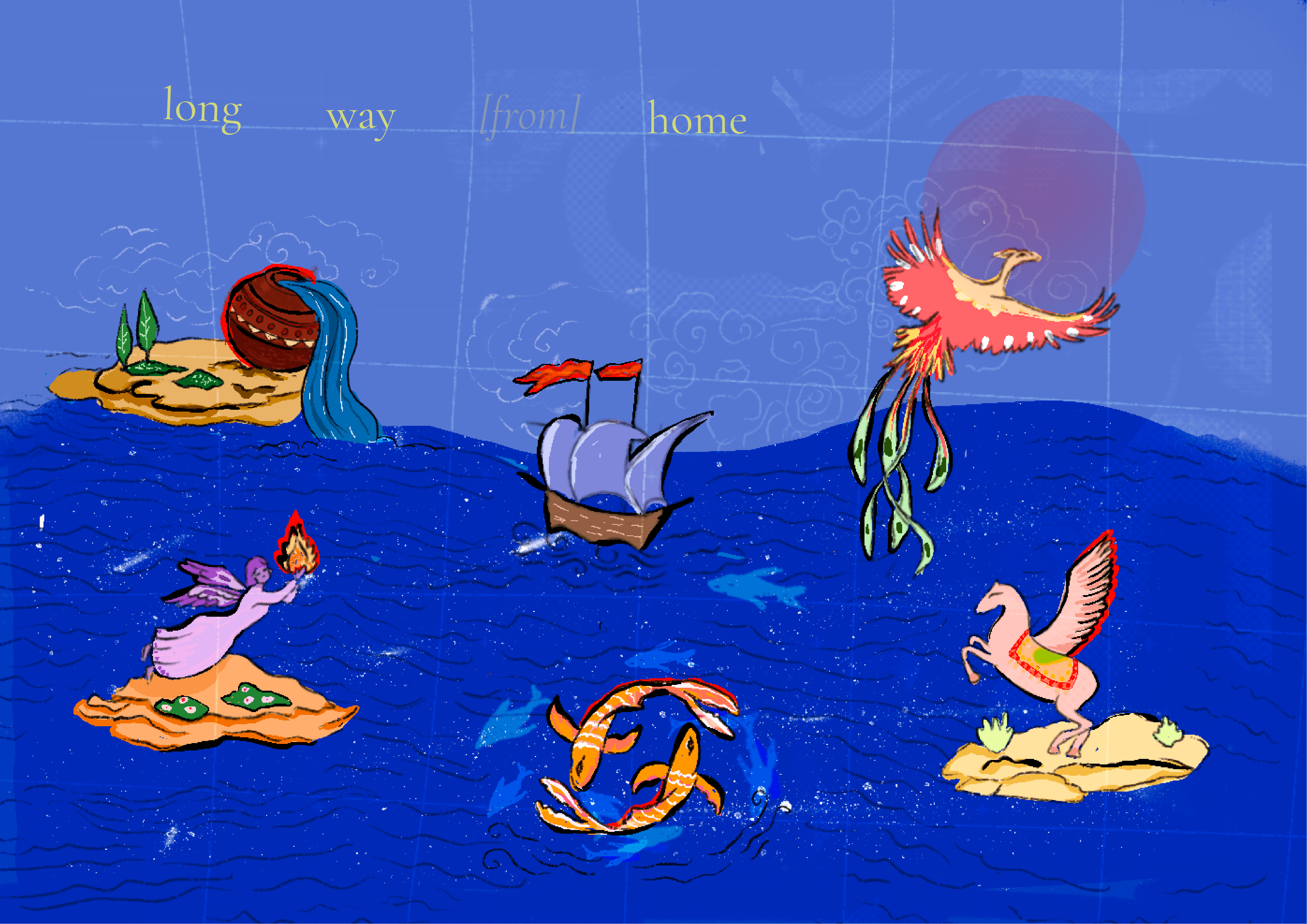
. At a foundational level, I felt my conceptual “home” being dismantled. What carried me through this uncertainty was a commitment to curiosity; not as optimism, but as a method for staying open when certainty was unavailable.
Practically, this shift has changed how I evaluate care in my practice. Rather than measuring success of my designerly doings is not through novelty, scale or outcomes but, small set of guiding questions to remain accountable before, during and after a project:
Can my work create ease?
Can my work remove pain, confusion or loneliness?
Can my work bring belonging, joy or repair?
If my work can meaningfully address even one of these, I will understand that I’m on my way and there's still a long way home.